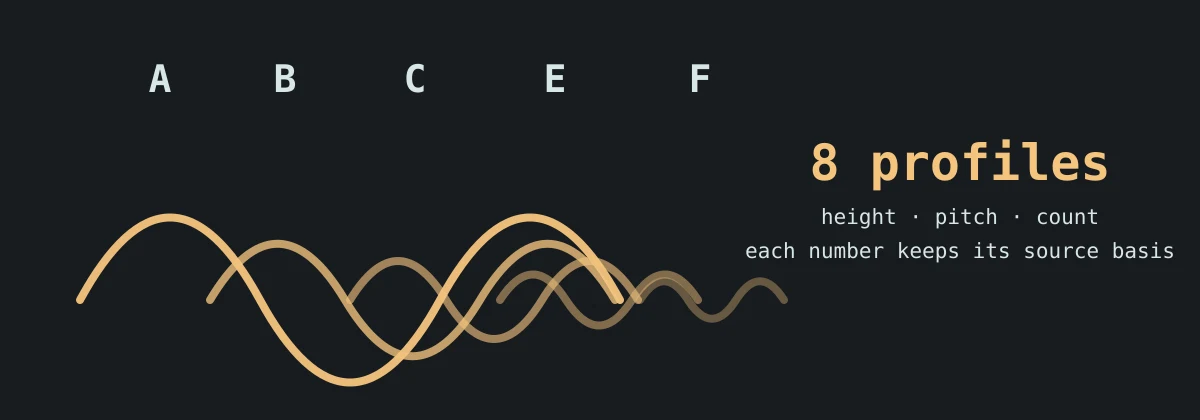
By Green Bay Dock Door Repair Research
Last verified: September 15, 2026
Corrugated Flute Chart: Sizes, Flute Counts, and What Every Number Actually Measures
What are the key corrugated flute statistics?
This corrugated flute chart separates published dimensions, image-derived estimates and arithmetic checks. The figures below keep the measurement basis attached to the number.
11/64 inch is 4.365625 mm—not 3.2 mm, a difference of 36.4% relative to 3.2 mm. The inconsistent C-flute pairing appears on five reviewed pages from four publishers: Box Genie, Arvco, Pakoro and Box Agency. This is a unit-conversion mismatch, not a measured variation in board. Sources and arithmetic checked September 15, 2026; the five-page audit and NIST conversion basis.
ISO 3034:2011 describes a method for determining single-sheet corrugated-board thickness. Its public abstract is not an A/B/C/E/F dimension chart; inspecting that abstract does not establish what every standard contains. International Organization for Standardization, catalogue checked September 15, 2026. Source.
FBA's “What is Corrugated?” page lists five profiles by approximate flutes per foot and gives no numeric thickness for those profiles. It explicitly allows profile variation within a designation. Fibre Box Association, undated page checked September 15, 2026. Source.
Board thickness minus flute height is 0.43–0.69 mm across the three C-, B- and E-flute examples in Table 1 of a 2023 image-analysis study. These are differences calculated from the paper's image-derived estimates, not new caliper tests. Rogalka, Grabski and Garbowski, Sensors 2023, 23(13):6242; checked September 15, 2026. Source and calculation.
The same study reports 8.13 mm flute period and 3.60 mm flute height for its C-flute example. The period is outside Summa's 6.8–7.9 mm C reference band, while the height is inside its 3.1–3.9 mm C band. Sensors, 2023; Summa, modified December 18, 2024; both checked September 15, 2026. Comparison.
President Container Group uses the same 3.2–4.0 mm C-flute range under two measurement labels: board caliper on one page and flute height on another. Four of its reference pages are compared below; these are not four independent measurements. Undated pages checked September 15, 2026. Source comparison.
FBA's approximate counts are A 33, B 47, C 38, E 90 and F 125 flutes per linear foot. These are association reference values, not counts measured by this site. Fibre Box Association, undated page checked September 15, 2026. Source.
FEFCO's indicative heights, excluding facings, are A 4.8 mm, B 2.4 mm, C 3.6 mm, E 1.2 mm and F/G/N grouped at 0.5–0.8 mm. The grouped entry is not an F-only specification. FEFCO, Table 2, table date not separately stated; checked September 15, 2026. Source.
FEFCO's C-flute example uses 1.43 m² of flat medium per 1 m² of board. That is a take-up factor, not the total paper in the board or a dollar-cost estimate. FEFCO, undated production reference checked September 15, 2026. Source.
Summa lists eight flute letters: G, F, E, D, B, C, A and K. Its D, G and K entries extend beyond the five A/B/C/E/F profiles in FBA's introductory reference. Summa, modified December 18, 2024; FBA, undated; checked September 15, 2026. Chart.
3/16 inch is exactly 4.7625 mm; rounding to one decimal gives 4.8 mm. The 0.0375 mm difference is rounding, not a measured manufacturing variation. PakFactory's published A-flute fraction; conversion using NIST's unit definition; checked September 15, 2026. Conversion table.
Single-wall board has three paper layers; double-wall board has five. Those totals count liners and fluted mediums, not glue as another paper layer. Fibre Box Association's construction definitions, undated page checked September 15, 2026. Source.
Contents: The chart · What the numbers measure · Why charts disagree · Is there a standard? · Flutes per foot · Take-up factor · Letters beyond A to F · Converting the units · How strength is specified · Flutes made in Brown County · Methodology · Limitations · How to cite · FAQ · Sources and downloads
What does this corrugated flute chart show?
Every figure below carries the publisher who printed it and the measurement that publisher named; all references were checked September 15, 2026. The columns are not interchangeable: flute height and assembled-board caliper describe different things, and these independent references are not the specifications of a single board.
Table 1. Corrugated flute chart, by source and measurement basis
Sources: Fibre Box Association, “What is Corrugated?”; FEFCO, “Corrugated board production,” Table 2; Summa, “F Series – Packaging Info,” modified December 18, 2024; President Container Group, “Caliper”; PakFactory, “Flute Specifications.” Dates are not stated in the other inspected references. Metric equivalents in the final column are calculations at exactly 25.4 mm per inch. All references checked September 15, 2026.
How to read the columns
The FEFCO column is flute height with the facings excluded. The two flat linerboards attached to either side are not included in that stated measurement. Its numbers are explicitly indicative examples, not a universal dimensional requirement. FEFCO.
The President Container Group column is board caliper. That publisher defines caliper as the entire cross-section: the linerboard faces, the fluted medium and the adhesive bonds. On a given board, assembled thickness and a height that excludes its facings are different quantities; separate publishers' figures cannot be treated as paired measurements. President Container Group.
The Summa columns give a height band and a pitch band. Pitch is the crest-to-crest spacing. Divide 304.8 by pitch in millimetres to calculate flutes per foot; the calculation does not turn a reference band into a product tolerance. Summa places its table under a DIN 55468 heading, but the ranges here are attributed to Summa because the full DIN text was not inspected. Summa.
The final column preserves the inch fractions printed in PakFactory's chart under its “Flute Thickness” heading. They are that publisher's reference values, not a claim that every supplier uses the same ordering dimension or that every caliper gauge should read below them. The exact conversion changes the unit, not the meaning or accuracy of the source. PakFactory; NIST.
Dataset, version 2.1.0: Source records, CSV · Complete dataset, JSON · Complete data and reproduction files, ZIP.
The source CSV contains 44 reference rows from eight publishers or author groups, with original labels, units, source dates where stated, verification dates and evidence roles. The JSON also includes the five-page unit audit, derived comparisons, image-study inputs and manufacturer-source audit. Methodology and field definitions · Neutral attribution details.
What does “flute thickness” actually mean?
Three distinct measurements appear in the references: flute height, flute pitch and finished-board caliper. In the three examples from the cited 2023 image-analysis paper, calculated board thickness minus flute height ranges from 0.43 to 0.69 mm; those examples show why the label and method need to travel with the number. FEFCO; Summa; Sensors study.
Flute height
Flute height describes the vertical extent of the corrugation rather than the finished sheet with its facings. FEFCO explicitly excludes facings. In the image-analysis paper, the flute shape is approximated with fitted geometry, so its height parameter should not silently be treated as a pressure-gauge board-caliper reading. FEFCO; Sensors study.
Flute pitch
Pitch is the repeating crest-to-crest spacing. It determines a corresponding flute count per unit length, which can be compared only after the units are aligned. Summa publishes pitch bands alongside height bands, keeping the two dimensions separate. Summa.
Board caliper
Caliper is the thickness of the finished sheet, including its liner faces and corrugated assembly. President Container Group notes that automated packaging machinery is configured for particular board thicknesses. ISO 3034:2011 addresses a method for measuring single-sheet thickness; the study below instead estimates dimensions from cross-section images. President Container Group; ISO; Sensors study.
Adding the image-study's reported flute-height parameter and its two liner estimates does not reproduce its reported board-thickness estimate. That is a check on those reported parameters, not proof that ordinary layer geometry ceases to add up.
Table 2. Flute height and board thickness estimated from the same cross-section examples
| Flute example | Image-derived flute height | Image-derived board thickness | Board minus flute height, calculated | Sum of reported liner thicknesses, calculated | Residual: board − flute height − liners, calculated |
|---|---|---|---|---|---|
| C | 3.60 mm | 4.29 mm | 0.69 mm | 1.00 mm | −0.31 mm |
| B | 2.70 mm | 3.13 mm | 0.43 mm | 0.82 mm | −0.39 mm |
| E | 1.30 mm | 1.79 mm | 0.49 mm | 0.82 mm | −0.33 mm |
Source: Rogalka, Grabski and Garbowski, Sensors 2023, 23(13):6242, Table 1, published July 7, 2023, CC BY 4.0. Difference, liner-sum and residual columns calculated by Green Bay Dock Door Repair Research from the published millimetre values. Source and calculations checked September 15, 2026.
The residuals run from −0.31 to −0.39 mm. The paper describes image-based identification and fitted flute geometry, and explains that sample deformation, cutting and stray fibres affect its estimates. These residuals do not establish a physical cause such as liners nesting into glue lines, and we do not assign one. Sensors study.
The practical rule is simple: do not derive liner thickness by subtracting one publisher's flute height from another publisher's board caliper. Even a same-example comparison needs compatible definitions and measurement methods.
Why do published corrugated flute charts give different numbers?
The reviewed pages mix different measurement bases, overlapping reference ranges and, in five cases, an inconsistent unit pairing. Manufacturing variation is another documented factor, but identical wording alone cannot establish a copying history. Five-page audit; FBA.
The repeated sentence
A C-flute description pairing 3.2 millimetres with 11/64 inch appears, with wording variations, on five pages from four publishers. Two pages belong to Arvco. The two dimensions are not equivalent; that conclusion needs no assumption about where the sentence originated.
Table 3. The “3.2 mm or 11/64 inch” C-flute pairing on five publisher pages
| Publisher and page | Date visibly stated on page | Published pairing, short excerpt | 11/64 in converted, rounded | Difference relative to stated 3.2 mm |
|---|---|---|---|---|
| Box Genie — guide | December 9, 2021 | “about 3.2 millimeters or 11/64 inches” | 4.366 mm | +1.166 mm; +36.4% |
| Arvco — FAQ | not stated in inspected content | “about 3.2 millimeters or 11/64 inches” | 4.366 mm | +1.166 mm; +36.4% |
| Arvco — flute article | not stated in inspected content | “about 3.2 millimeters–11/64 inches” | 4.366 mm | +1.166 mm; +36.4% |
| Pakoro — flute article | January 9, 2025 | “Approximately 3.2 millimeters (11/64 inches)” | 4.366 mm | +1.166 mm; +36.4% |
| Box Agency — guide | March 18, 2025 | “around 3.2 millimeters or 11/64 inches” | 4.366 mm | +1.166 mm; +36.4% |
Sources: the five named publisher pages, inspected September 15, 2026; NIST for the conversion basis. Dates describe the date displayed by each page, not the first appearance of the quoted wording. The unrounded calculation is (4.365625 − 3.2) ÷ 3.2 × 100 = 36.42578125%.
For comparison, 1/8 inch is exactly 3.175 mm, which rounds to 3.2 mm at one decimal place. It is not exactly 3.2 mm. The B-flute passages on the same five pages use the 1/8-inch pairing, while the C-flute passages attach 3.2 mm to a different fraction. The distinction between legitimate rounding and a different fraction is the issue. Publisher audit sources; NIST.
We are not assigning blame or a direction of copying. The current pages establish a repeated unit inconsistency; their publication dates do not establish that the wording remained unchanged since publication. This is a source-checking finding, not a five-year propagation study.
The same publisher, four reference pages
Different labels also appear within one manufacturer's own site. This is a useful comparison because it holds the publisher constant, but the pages are still separate references rather than measurements of one specimen.
Table 4. Four C-flute references published by President Container Group
| Page | Publication or revision date in inspected content | C-flute figure published | Measurement label used |
|---|---|---|---|
| Caliper | not stated | 3.2–4.0 mm | caliper; entire cross-section |
| C-Flute Corrugated | not stated | 3.2–4.0 mm; 39–43 flutes per foot | flute height |
| BC Flute (Double Wall) | not stated | roughly 3.5–4 mm; 39 flutes per foot | thick |
| Inside Dimensions | not stated | approximately 5/32 inch; equivalent to 3.96875 mm before rounding | board caliper |
Sources: President Container Group's four linked pages. The millimetre equivalent of 5/32 inch is calculated, not a separately published measurement. All pages and the conversion checked September 15, 2026.
The same 3.2–4.0 mm range is presented as caliper on one page and flute height on another. That label difference is worth preserving. The overlapping ranges and approximate fraction do not, by themselves, prove four conflicting specifications or an error in a particular manufactured board.
Real manufacturing variation
The Fibre Box Association states that profiles can vary within a designation because corrugator rolls are made for different operating speeds, paperboard characteristics and economics. A flute letter therefore needs the relevant supplier's dimensional description beside it when an exact geometry matters. That documented variation should not be confused with the arithmetic error in Table 3. FBA.
Is there a standard that sets corrugated flute dimensions?
A measurement method, an indicative association chart and a board specification are different kinds of document. The public material checked below establishes their stated subjects, but it does not justify a blanket claim that no standard contains flute dimensions. ISO; ASTM; DIN Media.
Table 5. What the checked association and standards material establishes
| Body | Document checked | What the accessible material covers | What this review can establish about flute height |
|---|---|---|---|
| Fibre Box Association | “What is Corrugated?” | Approximate flutes per foot; board-construction definitions | This particular page does not give numeric thicknesses. That is not a conclusion about every FBA publication. |
| FEFCO | Corrugated board production, Table 2 | Heights, counts, take-up factors and glue use | Its figures are expressly indicative examples, not presented as a mandatory dimension table. |
| ISO | Public catalogue and abstract for ISO 3034:2011 | Determination of single-sheet thickness for corrugated fibreboard, with conditioning referenced to ISO 187 | Establishes a measurement-method scope. The full standard was not inspected. |
| ASTM International | Public scope and abstract for D4727/D4727M-22 | Corrugated and solid fibreboard sheet stock, grades and physical/performance requirements | The abstract is not a complete dimensional specification. No claim is made about provisions not visible in the full text. |
| NMFTA | Official packaging guidance on NMFC Item 222 and the BMC | Fibreboard-box construction, size/weight limits, material strength and certification | The public guidance does not provide an A/B/C/E/F height table. It is not a complete reproduction of Item 222 or a review of rail rules. |
| DIN Media | Catalogue for DIN 55468-1:2021-01 | Corrugated fibreboard requirements and testing | Confirms a separate relevant standard exists. Summa's ranges remain attributed to Summa because the full DIN text was not inspected. |
Sources: FBA, FEFCO, ISO 3034:2011, ASTM D4727/D4727M-22, NMFTA and DIN Media. Public pages checked September 15, 2026; paid full standards were not reviewed.
ISO's catalogue identifies ISO 3034:1975 as withdrawn and points to ISO 3034:2011. That edition history is distinct from a claim that an introductory flute chart is itself an ISO specification. ISO catalogue history.
Wikipedia's table is retained in the downloadable publication audit only as a record of what that encyclopedia displayed. We did not establish an issuing standard behind its per-letter numbers, and we do not use it to certify a size, a tolerance or a market share. The inch fractions in the main chart instead have a named packaging-publisher source, PakFactory. Wikipedia audit record; PakFactory.
How many flutes per foot is each flute profile?
FBA lists approximately 33 for A, 47 for B, 38 for C, 90 for E and 125 for F. Pitch-based counts from another publisher can be placed beside those figures, but the comparison is arithmetic—not a pass/fail standard or proof that all sources agree within a fixed percentage. FBA; Summa.
Summa publishes pitch in millimetres. Dividing 304.8 by each endpoint reverses the order of a pitch range: a shorter period means more flutes per foot. The calculation below is this page's reproducible comparison, not a claim to have invented that conversion.
Table 6. Flute pitch converted to flutes per foot, beside FBA's approximate counts
| Flute | Flute pitch (Summa) | Calculated flutes per foot, rounded | FBA approximate flutes per foot | Literal numerical comparison—not a tolerance test |
|---|---|---|---|---|
| G | ≤ 1.8 mm | ≥ 169.3 | not listed | no FBA comparison |
| F | 1.9–2.6 mm | 117.2–160.4 | about 125 | printed number lies inside calculated interval |
| E | 3.0–3.5 mm | 87.1–101.6 | about 90 | printed number lies inside calculated interval |
| D | 3.8–4.8 mm | 63.5–80.2 | not listed | no FBA comparison |
| B | 5.5–6.5 mm | 46.9–55.4 | about 47 | printed number lies inside calculated interval |
| C | 6.8–7.9 mm | 38.6–44.8 | about 38 | printed number is below calculated interval; FBA gives no precision bound here |
| A | 8.0–9.5 mm | 32.1–38.1 | about 33 | printed number lies inside calculated interval |
| K | ≥ 10 mm | ≤ 30.5 | not listed | no FBA comparison |
Sources: Summa, modified December 18, 2024; FBA, undated. Counts calculated at exactly 304.8 mm per foot; one-decimal endpoints are rounded display values. Sources and calculations checked September 15, 2026.
For C flute, FEFCO's indicative 130 flutes per metre converts to about 39.6 per foot, while FBA prints about 38. The image-study example converts to about 37.5 per foot. These are different published references and one sample estimate—not a basis for changing a supplier's C designation to another letter. FEFCO; Sensors study.
Table 7. Flute counts calculated from published image-derived periods
| Flute example | Published flute period | Calculated flutes per metre | Calculated flutes per foot | FBA approximate count per foot |
|---|---|---|---|---|
| C | 8.13 mm | 123.0 | 37.5 | about 38 |
| B | 6.39 mm | 156.5 | 47.7 | about 47 |
| E | 3.50 mm | 285.7 | 87.1 | about 90 |
Sources: Rogalka, Grabski and Garbowski, Sensors 2023, Table 1; FBA. Counts calculated at 1,000 mm per metre and 304.8 mm per foot, rounded to one decimal. Checked September 15, 2026.
One comparison is worth stating plainly. The study's C example has an 8.13 mm period: above Summa's C pitch band and inside its A pitch band. The same example's 3.60 mm height is inside Summa's C height band. Those cross-source placements are reproducible, but they do not show that the authors misidentified the sample or that it failed an applicable standard. They show the risk of treating independent reference bands as a universal classification test.
What is take-up factor, and how much paper does each flute use?
Take-up factor compares the length or area of flat corrugating medium with the corresponding projected board length or area. FEFCO's C example is 1.43 m² of medium per 1 m² of board; this is one material-use input, not a complete cost or total-paper calculation. FEFCO.
FEFCO's indicative range is 1.50–1.55 for A and 1.15–1.25 for its grouped F/G/N entry. These references describe different profiles, and height alone does not determine take-up: pitch and waveform matter too. The liners, medium basis weight, adhesive and waste also remain outside a simple medium-length ratio. FEFCO.
We compared those indicative ranges with an explicitly hypothetical sine-wave model using the image-study's reported height and period. The derived factor is the arc length of one model period divided by that period. It is not a measurement of actual paper consumption, and the study and FEFCO references do not describe matched production samples.
Table 8. Take-up factor: FEFCO references versus a sine-wave calculation
| Flute | Sine-model factor from the study's image-derived geometry | FEFCO indicative range | Numerical relationship—not a validation verdict | FEFCO glue use, g/m² per glue layer |
|---|---|---|---|---|
| A | no image example used | 1.50–1.55 | no model comparison | 4.5–5.0 |
| B | 1.352 | 1.30–1.35 | approximately 0.002 above upper endpoint | 5.5–6.0 |
| C | 1.380 | 1.40–1.45 | approximately 0.020 below lower endpoint | 5.0–5.5 |
| E | 1.283 | 1.20–1.35 | inside reference interval | 6.0–6.5 |
| F, G, N grouped | no image example used | 1.15–1.25 | not assigned to F alone | 9.0–11.0 |
Sources: FEFCO, Table 2, for take-up and glue figures; Sensors study, Table 1, for geometry inputs. Model calculations by Green Bay Dock Door Repair Research, checked September 15, 2026. FEFCO's glue denominator is one square metre per glue layer, not the total glue in every square metre of finished board.
The modeled B result is above its corresponding FEFCO range; C is below; E is inside. That does not establish a systematic under-prediction on taller flutes, and it cannot identify flat flute tips or any other physical cause. The sources describe different references, so proximity is a numerical comparison rather than experimental validation.
The model uses y = (h/2) × sin(2πx/p) and integrates its arc length over one period. It does not model paper strain, compressed tips, adhesive or production losses. Its inputs, assumptions and runnable calculation are included with the dataset so the result can be checked without mistaking it for a factory measurement.
FEFCO's worked board example also distinguishes the glue layers: two applications at 5 g/m² each total 10 g/m². The per-layer denominator is therefore essential when quoting its table. FEFCO.
What do the flute letters beyond A, B, C, E and F mean?
The five profiles in FBA's introductory chart are not an exhaustive list of every designation in published manufacturer material. Summa adds D, G and K, while DS Smith's sheetfeeding range also includes combined profiles and its R-Flute branding. FBA; Summa; DS Smith.
The letters the five-profile chart leaves out
In Summa's reference, D sits between E and B at 1.9–2.1 mm height and 3.8–4.8 mm pitch. G is listed at 0.55 mm height or less, and K at 5.0 mm or more. These are Summa's published ranges, not a claim that every supplier uses these letters or dimensions identically. Summa.
The source's G, F, E, D, B, C, A, K sequence also makes clear why this page does not stop at A through F. Missing letters on an introductory chart are not proof that a profile does not exist.
Why the letters are not in size order
FBA describes A as the original profile, B as a development for self-supporting canned goods, C as the next all-purpose profile, E as a later development and F as intended for smaller folding-carton-type uses. That history explains why those familiar letters are not a descending or ascending size scale. It does not establish a single worldwide naming history for every later microflute or branded profile. FBA.
Combined flutes and multiwall
Double-wall board combines two fluted mediums with three liners. A combined label such as BC or EB identifies profiles in the assembly; it does not supply the finished sheet's guaranteed caliper or load rating. Single face has two paper layers, single wall three, double wall five and triple wall seven, following FBA's construction definitions. FBA.
DS Smith Sheetfeeding lists BC, RB, EB, EE, NE, C, B, R, E, F and N: eleven entries. Its page describes BC in stacking applications and EB where printing and performance matter, but that does not establish that every EB board is weaker than every BC board. The same page presents R-Flute® as a branded profile; this review is not a trademark-register audit. DS Smith.
A flute is not named in every published range
We checked three specific published ranges or declaration scopes in the United Kingdom, United States and Mexico. None of those three entries names A flute. That is a finding about the selected pages, not evidence of scarcity across the market.
Table 9. Flutes named in three manufacturer references
| Manufacturer and source scope | Published range or declaration scope | A named in this source? |
|---|---|---|
| DS Smith Sheetfeeding — published range | BC, RB, EB, EE, NE, C, B, R, E, F, N | No |
| Green Bay Packaging — Green Bay Shipping Container Division plant page | B, C, E and double wall | No |
| Grupak — product scope in its registered Environmental Product Declaration | Single wall B, C, E; double wall BC, BE, BB, CE | No |
Sources: DS Smith; Green Bay Shipping Container Division; EPD International's Grupak registry entry, EPD-IES-0026746:002, version November 26, 2025. The registry identifies ISO 14025:2006 as the declaration standard. Source scopes checked September 15, 2026.
Three source scopes are not a market survey. An environmental declaration does not necessarily cover every product a company sells, and an omission from a plant page is not proof of unavailability. Green Bay Packaging's company-wide page explicitly includes A flute, illustrating why the corporate and plant scopes must stay separate. Company-wide capabilities.
How do you convert flute measurements without changing what they mean?
One international foot is exactly 304.8 mm, so one inch is exactly 25.4 mm. A conversion preserves the source's measurement basis and uncertainty; it cannot turn an indicative reference into a measured specification. NIST.
The formulas:
inches            = millimetres ÷ 25.4
flutes per foot   = flutes per metre × 0.3048
flutes per metre  = flutes per foot ÷ 0.3048
flutes per foot   = 304.8 ÷ pitch in millimetres

Worked example:
130 flutes per metre × 0.3048 = 39.624 flutes per foot.
Displayed as about 39.6, preserving the approximate source meaning.
Converting 130 to 39.624 does not make the source precise to three decimal places. It was an indicative number before the conversion and remains one afterwards. Likewise, a count per 300 mm must be multiplied by 1.016 to express the same spacing per foot; simply changing the label is not a conversion.
Table 10. Exact conversions and one-decimal rounding of five published fractions
| Flute | Fraction published by PakFactory | Exact conversion | Calculated value rounded to one decimal | Rounding gap: rounded − exact |
|---|---|---|---|---|
| A | 3/16 in | 4.7625 mm | 4.8 mm | +0.0375 mm |
| B | 1/8 in | 3.175 mm | 3.2 mm | +0.025 mm |
| C | 5/32 in | 3.96875 mm | 4.0 mm | +0.03125 mm |
| E | 1/16 in | 1.5875 mm | 1.6 mm | +0.0125 mm |
| F | 1/32 in | 0.79375 mm | 0.8 mm | +0.00625 mm |
Sources: PakFactory for the published inch fractions; NIST for exact units. Both metric columns and the differences are calculations by Green Bay Dock Door Repair Research, checked September 15, 2026.
For these five calculations, the one-decimal result is approximately 0.7874% greater than the exact converted value. That is a reproducible rounding relationship. It does not establish that every website's millimetre figure originated as an inch conversion, and it says nothing about a particular board's measured thickness.
There is no universal “the gauge reads below the fraction” rule established by the sources in this table. A supplier's declared measurement, conditioning and test method remain separate from a reference fraction. Those details matter more than displaying extra decimal places. ISO 3034; FBA's variation statement.
How is corrugated board strength actually specified?
A flute letter is not a load rating. NMFTA's packaging guidance treats material strength, box dimensions, gross-weight limits and the Box Manufacturer's Certificate as distinct information; a burst or edge-crush result is not itself a payload in pounds. NMFTA; BMC explanation; TAPPI.
The certificate on the box
NMFTA identifies Item 222 as the NMFC provision covering fibreboard-box standards, including size and weight limits, material strength and the required certificate. Its BMC explanation shows test information separately from a gross-weight limit. This page does not reproduce the full current Item 222 tables or certify a box for a shipment. NMFTA; BMC explanation.
The International Safe Transit Association distinguishes those material/construction requirements from its own packaged-product performance tests. Its guidance also distinguishes the rail-oriented UFC Rule 41 from motor-freight Item 222; the full rail rule was not inspected for this reference, so no Rule 41 thresholds or compliance claim are presented here. ISTA's explanation.
A certificate and a flute designation do not replace assessment of the packed product, cushioning, closure, storage conditions or distribution hazards. A qualification tied to a test or transport mode should not be expanded into a guarantee that a product cannot be damaged. ISTA.
The tests behind the numbers
TAPPI's published method list includes T 811 for edgewise compressive strength and T 839 for the clamp-method version. It lists T 810 for bursting strength, T 808 and T 825 for flat crush using different apparatus, T 804 for compression of shipping containers, and T 826 for short-span compression of containerboard. These are method identifiers, not a statement that every edition was read or every test is interchangeable. TAPPI method list.
The listed tests concern distinct mechanical properties; flute height and count do not replace their results. Edge-crush resistance, bursting strength and whole-box compression are different quantities, so an unsupported one-to-one conversion between their values would misstate what was tested. TAPPI; ISTA.
The papers and their orientation still matter
Board strength also depends on the papers, not just the flute letter. The cited research identifies the individual paper layers, flute geometry and environmental conditions among the factors affecting board behaviour. This reference does not assign virgin-fibre percentage thresholds to liner or medium categories without an inspected defining document. Sensors study.
Corrugated board has direction-dependent mechanical behaviour. The layer arrangement and the direction in which a property is tested therefore matter; a single thickness number does not encode a complete bending or compression specification. The image-analysis paper discusses its geometry work as input to mechanical modelling, not as a replacement for performance testing. Sensors study; TAPPI.
Specifying board for a load-bearing or stacking application is engineering work. The flute letter is an input to it, not an answer. A packaging professional needs the actual construction and relevant performance evidence rather than a generic chart alone.
Which flutes are actually made in Green Bay and Brown County?
Green Bay Packaging's Green Bay Shipping Container Division names B, C and E flute and double-wall construction, and states that it has an in-house corrugator. The company's Green Bay mill separately produces linerboard and medium; those pages establish local capabilities, not the provenance of every sheet produced by the plant. Plant; Mill.
This section checks what particular company pages establish, not every manufacturer in Wisconsin or Brown County. A corporate capability page and a single plant page support different scopes of claim, and a city or county label does not create a new flute specification.
Table 11. What two Green Bay Packaging pages establish
| Page and scope | What it establishes | What it does not establish |
|---|---|---|
| Corrugated converting capabilities — company-wide | Explicitly lists A, B, C and E flute options, plus singlewall and doublewall construction | Does not assign every corporate capability to the Green Bay plant |
| Green Bay Shipping Container Division — Green Bay plant | Names B, C and E flute and double wall; states in-house corrugation and service to Wisconsin, Illinois, Iowa and Indiana | Gives no numeric flute-height or flute-count table. A or F not being named does not prove unavailability |
Sources: Green Bay Packaging's company-wide converting page and Green Bay Shipping Container Division page, checked September 15, 2026. The county context is also identified in the company's mill project announcement; this is not a countywide manufacturer census.
The paper side is in the same city. Green Bay Packaging describes its Green Bay mill as using 100% recycled materials to produce linerboard and medium. Its capability page lists medium weights as 23–33 lb, but omits the area denominator in that passage. We preserve that wording as a source statement, not as a roll weight or a fully specified basis-weight range. Green Bay Mill.
Project contractor Miron identifies completion in March 2021, replacement of an operation built in 1948, and an expenditure exceeding $500 million. The company's 2018 announcement described the project as Wisconsin's first new paper mill in more than 30 years; that is a dated project statement, not a present-day statewide census. Miron project record; Green Bay Packaging announcement.
Equipment supplier Voith specifies 685,000 short tons per year for the machine's planned production capability. The unit is short tons, and the figure is a design/capacity statement—not independently measured annual output. Voith.
Wisconsin Paper Council describes Wisconsin as America's leading papermaking state for more than 50 years. That is the council's statewide historical statement; it is not evidence that Green Bay holds a particular national rank in corrugated manufacturing. Wisconsin Paper Council.
A flute profile does not acquire a new definition at a county line. The local sources establish that medium and linerboard are produced here and that corrugation capability is located here. They do not trace an individual roll from one facility into a specific batch at another, and this reference makes no such batch-level claim.
How was this reference built?
The released dataset contains 44 source-reference rows from eight publishers or author groups, rechecked September 15, 2026; the three image-study examples are included in those 44 rows, not additional observations. We measured no physical board: the original contribution is the source-labeled compilation, publication audit and reproducible calculations, including a separately labeled geometry model.
What we collected
For each numerical reference row, we recorded the flute letter or original group, numeric value, the publisher's measurement label, original units, source URL, source date where stated and verification date. We preserved FEFCO's F/G/N entry as one grouped observation rather than manufacturing three records from one example. A blank means the value was not published in that field or could not be directly transcribed; it never means zero.
The raw CSV keeps published numbers separate from calculated outputs. It has dedicated fields for flute height, pitch, counts, board caliper, an unspecified published thickness, inch fractions, take-up factor and glue consumption per square metre per glue layer. The image-study records also retain upper-liner, lower-liner and medium-material thickness inputs so the residual calculations can be reproduced.
A verification date records the source check, not the date the underlying measurements were made. Visible source dates are preserved separately. Search-index timestamps, copyright years and dates on unrelated references are not substituted for missing publication dates.
Where we collected from
The 44-row source file contains five FBA rows, five FEFCO rows, eight Summa rows, eight President Container Group rows, five PakFactory rows, five Wikipedia audit rows, five WebstaurantStore audit rows and three author-group rows from Sensors. These are published reference records, not 44 independently tested boards or eight independent laboratories.
The Wikipedia and WebstaurantStore rows are retained only to audit their displayed numbers and labels. They do not establish authoritative profile dimensions. In the retrieved Wikipedia rendering, the fraction cells were not legible; those raw fields are left empty rather than silently filled from another site's table. The main chart's five fractions were verified separately against PakFactory.
The unit-pairing audit is a separate five-page table with four publisher identities. It includes two Arvco pages and does not claim five independent publishers. A separate four-row manufacturer-source file covers the three scopes in Table 9 plus Green Bay Packaging's company-wide page, also used in Table 11.
This is a selected reference corpus, not an exhaustive or random sample of all flute charts. The numbers of pages and publishers describe this dataset alone; they are not prevalence estimates for errors on the internet.
Verification status and evidence roles
Directly checked numerical records are marked ★ in the reference's verification convention. That mark means the value or wording was checked against the named publisher's own material within its stated scope. It does not mean the site performed physical testing, audited a manufacturer or read a standard referenced by that page.
The machine-readable files additionally distinguish PRIMARY_PUBLICATION, PRIMARY_STUDY and AUDIT_ONLY. A publisher is primary evidence of what its own page says; that does not make every assertion on the page a validated technical fact. No record awaiting direct re-verification is presented as a released technical value.
Summa's ranges are attributed to Summa. Its DIN heading is not used to imply inspection of the underlying DIN clauses. The ISO, ASTM and DIN entries are limited to the public catalogue material identified in the source directory, and the same boundary applies to the carrier guidance.
What we calculated
All numeric derivations use the saved source inputs, not values fetched during script execution. The outputs cover pitch-to-count conversion; period-to-count conversion; exact fraction-to-millimetre conversion; one-decimal rounding differences; the 3.2 mm versus 11/64-inch mismatch; the image-study thickness differences and residuals; and the explicitly hypothetical sine-wave take-up model.
The mismatch percentage uses 3.2 mm as its denominator. A different denominator would give a different percentage, so the published 36.4% always refers to that stated millimetre value. It does not represent the proportion of inaccurate charts or a physical error in a manufactured sheet.
For the image-derived residual, the calculation is board thickness − flute height − upper liner thickness − lower liner thickness. The paper's reported millimetre values are the inputs. No glue thickness or mechanism is inferred from the difference, and no result is described as equivalent to an ISO 3034 pressure-gauge measurement.
For the sine model, height h is twice the amplitude and p is the period. The script integrates sqrt(1 + (πh/p × cos(2πx/p))²) across one period and divides by the period. It checks numerical convergence at two integration resolutions; that checks the numerical procedure, not whether a sine wave physically represents a particular production flute.
The script uses exact decimal/fraction arithmetic for conversions and sufficient floating-point precision for the model. Display rounding occurs after calculations. Extra digits in machine-readable outputs are computational precision, not additional precision in the original reference or image estimate.
Reproduction and updates
The Python script runs with Python 3.9 or later and standard-library modules only. With the three input CSV files beside it, python flute_geometry_v2.py regenerates the derived CSVs and consolidated JSON. It validates record identifiers, required provenance and corpus counts before writing outputs.
The script does not re-fetch the source pages or re-verify that their wording remains unchanged. Source checking is a separate editorial step. The visible verification date changes only after that work, not after a rebuild, a calendar change or a successful calculation run.
Recheck manufacturer capabilities and technical references quarterly, catalogue status semiannually and links monthly. A changed numerical input requires a new dataset version and rerun of all dependent calculations. Version 2.1.0 records this audit's corrections to source labels, dates, grouping, units, corpus counts and interpretation; it does not claim newly sampled factory data.
The Fibre Box Association annual report boundary
FBA's public listing for its 2024 annual report describes production and shipment statistics, but the report's underlying tables were not inspected for this reference. No single-wall market-share percentage is therefore published here. The listing is identified in the source directory as an access boundary, not cited as evidence for an unseen number. FBA report listing.
What can this chart not tell you?
This is a compilation of published references, selected image-study examples and declared calculations—not a product specification or manufacturer census. It cannot establish the exact dimensions, tolerance, strength or suitability of a board that has not been identified and tested.
We measured no board. The three image examples come from Table 1 of a larger published study, not a three-sample industry survey conducted by this site. They are useful for checking how measurement definitions interact, not for estimating an industry average. The source also discusses how damaged cuts and crushed samples can affect image identification. Sensors study.
Ranges are not automatically tolerances. Summa's 3.1–3.9 mm C range is its published reference band. It becomes a contractual requirement only through an applicable specification or agreement, not because it appears in this comparative chart. Approximate FBA counts are not precise acceptance thresholds. Summa; FBA.
Columns are not paired specimens. FEFCO's height, PCG's caliper and PakFactory's fraction do not describe one matched sample. Subtracting them cannot establish liner thickness. The image-study residuals are also arithmetic comparisons of reported parameters, not a diagnosis of a physical construction mechanism.
The full standards were not reviewed. The checked ISO, ASTM and DIN catalogue pages have narrower evidentiary scope than the paid standards themselves. The public NMFTA and ISTA explanations are not the full carrier rules. This page does not claim that no dimensional standard exists or certify compliance with a standard's unseen provisions. Standards comparison.
The A-flute references are not resolved into one value. FEFCO lists 4.8 mm with facings excluded; PakFactory prints 3/16 inch under “Flute Thickness,” which converts to 4.7625 mm and rounds to 4.8 mm. That numerical closeness does not establish that either source mislabeled its value, because they are not measurements of the same specimen and their source precision differs. Both references remain attributed instead of being averaged. FEFCO; PakFactory.
No C-flute market-share percentage is established. An unsourced percentage repeated on a publisher page does not become a measured national statistic. No original market-share dataset was verified in this pass, and the annual report's unseen tables were not used as substitutes. FBA report access boundary.
Flute counts were not checked against production volumes. Counts per length and shares of manufacturing output answer different questions. The number of profiles or references in this dataset says nothing about the national proportion of boxes using a given profile.
The repeated pairing does not establish a copying chain. The five-page audit records the wording visible at review. It does not establish who first published it, who relied on whom, or whether the pairing was present on a page's original publication date. Nor does the calculation determine which of the two stated dimensions a publisher intended.
The geometry model is not a consumption test. FEFCO's indicative factors and the study's image-derived examples are not matched production observations. The model omits production effects and has no measured error distribution against factory paper use. Its numerical closeness to a reference interval does not validate it for pricing or process control.
Local scope is bounded. A corporation's capability list, a plant page and an EPD product scope are not interchangeable. Omissions do not prove unavailability, design capacity is not measured output, and nearby facilities do not prove a particular batch moved between them. Manufacturer table; Green Bay source comparison.
What are this page's citation details?
The bibliographic details below identify this compilation and dataset version. Individual source values retain their originating publisher's attribution; this page's original contribution is the joined comparison, five-page unit audit and reproducible calculations.
Publication: Green Bay Dock Door Repair Research
Page title: Corrugated Flute Chart: Sizes, Flute Counts, and What Every Number Actually Measures
Page URL: greenbaydockdoorrepair.com/research/corrugated-flute-chart/
Dataset version: 2.1.0
Last verified: September 15, 2026
Tables and key findings have stable anchors, including the main chart, the unit-mismatch audit, the sample-dimension comparison and the take-up model. The dates identify this reference's verification pass, not new 2026 measurements of the underlying board examples.
What else do readers ask about corrugated flutes?
The answers below use the named references rather than merging them into a universal specification. Dimensions, construction and strength remain separate questions even when they appear together on a supplier's chart.
Is C flute thicker than B flute?
In Summa's height ranges, C is 3.1–3.9 mm and B is 2.2–3.0 mm. FEFCO's indicative heights excluding facings are 3.6 mm and 2.4 mm respectively. Those references put C above B; the comparison does not promise the exact caliper of an unidentified finished board. Summa; FEFCO.
Which is thinner, E flute or F flute?
Summa lists F height at 0.6–0.9 mm and E at 1.0–1.8 mm. That reference puts F below E. FBA separately lists more flutes per foot for F than E, but a count alone is not a thickness measurement. Summa; FBA.
Does flute height include the liners?
FEFCO explicitly excludes facings from its flute-height values. Board caliper, as President Container Group defines it, includes the assembled cross-section. The source label matters: the terms should not be exchanged simply because both numbers use millimetres. FEFCO; PCG.
How many flutes per foot is C flute?
FBA says about 38. FEFCO's indicative 130 per metre converts to about 39.6 per foot, while Summa's C pitch band converts to about 38.6–44.8 per foot. Keep the named reference attached rather than replacing these different values with an invented universal average. FBA; FEFCO; Summa comparison.
Is double wall the same as two paper layers?
No. Double wall has five paper layers: three liners and two fluted mediums. Single wall has three, single face has two and triple wall has seven, using FBA's construction definitions and counting paper layers rather than adhesive. FBA.
Can a flute letter tell me how much a box will hold?
No. A flute letter is not a payload rating, and a burst or edge-crush test number is not a weight capacity. NMFTA distinguishes material strength from box size and gross-weight limits; suitability for a packed product also requires the relevant packaging assessment. NMFTA; BMC explanation; ISTA.
Are flutes per 300 mm the same as flutes per foot?
No. A foot is exactly 304.8 mm, so multiply a count per 300 mm by 1.016 to express the same spacing per foot. That conversion increases the numerical count by exactly 1.6%; changing the label without changing the number is incorrect. NIST; calculation method.
Why do different websites give different flute sizes?
Sources can describe different measurements and different reference profiles, and some pair units inconsistently. The five-page audit found a 36.4% discrepancy between 3.2 mm and the metric conversion of 11/64 inch, using 3.2 mm as the denominator. That establishes an arithmetic problem, not a copying history or a measured defect in a board. Audit; FBA.
What are D, G and K flute?
They are additional profile letters in Summa's published table. Summa gives D height as 1.9–2.1 mm, G as 0.55 mm or less and K as 5.0 mm or more. These remain attributed manufacturer-reference ranges, not a claim about every supplier's specification. Summa.
Which sources support this reference?
The directory separates technical references, primary research, public standards material and the publisher pages examined as audit subjects. Each listed source was checked September 15, 2026; a missing publication date remains unstated rather than being replaced with the verification date.
Fibre Box Association — “What is Corrugated?” Approximate counts, construction definitions, profile history and stated variation. No publication/revision date stated in the inspected page. https://www.fibrebox.org/what-is-corrugated
2. Fibre Box Association — 2024 Annual Report, public product listing. The listing was inspected, not the paid report tables. No production-share or furnish-percentage claim is derived from unseen material. https://store.fibrebox.org/collections/store-products/products/2024-fibre-box-association-annual-report
3. FEFCO — “Corrugated board production,” Table 2. European Database for Corrugated Board Life Cycle Studies; indicative heights excluding facings, counts, take-up factors and glue per square metre per glue layer. Table date not separately stated. https://www.fefco.org/lca/dscription-of-production-system/corrugated-board-production
4. Summa — “F Series – Packaging Info.” Modified December 18, 2024. Height/pitch ranges for G, F, E, D, B, C, A and K; underlying DIN text not reviewed. https://support.summa.eu/support/solutions/articles/43000680145-f-series-packaging-info
5. President Container Group — “Caliper – Corrugated Board Thickness Explained.” Caliper definition and A/B/C/E/F references. Publication/revision date not stated in inspected content. https://www.presidentcontainergroup.com/caliper/
6. President Container Group — “C-Flute Corrugated.” Its C-flute height/count statements; not used as evidence of national market share. Publication/revision date not stated in inspected content. https://www.presidentcontainergroup.com/c-flute/
7. President Container Group — “BC Flute (Double Wall).” C values retained with its original “thick” wording, without assuming a measurement basis. Publication/revision date not stated in inspected content. https://www.presidentcontainergroup.com/bc-flute-double-wall/
8. President Container Group — “Inside Dimensions: How Corrugated Box Sizes Are Specified.” Approximate 5/32-inch C-board-caliper reference. Publication/revision date not stated in inspected content. https://www.presidentcontainergroup.com/inside-dimensions/
9. Rogalka, M.; Grabski, J. K.; Garbowski, T. — “Identification of Geometric Features of the Corrugated Board Using Images and Genetic Algorithm.” Sensors 2023, 23(13), 6242; published July 7, 2023; DOI 10.3390/s23136242. Table 1 supplies the three image-derived examples. Open access under CC BY 4.0; the comparison, differences and sine-model calculations here are adaptations, not results claimed by the authors. https://www.mdpi.com/1424-8220/23/13/6242 — full-text repository alternative: https://pmc.ncbi.nlm.nih.gov/articles/PMC10346967/
10. International Organization for Standardization — ISO 3034:2011. “Corrugated fibreboard — Determination of single sheet thickness,” second edition. Public catalogue/abstract inspected; full standard not reviewed. https://www.iso.org/standard/51266.html
11. International Organization for Standardization — ISO 3034:1975. “Corrugated fibreboard — Determination of thickness”; catalogue identifies this edition as withdrawn and points to ISO 3034:2011. https://www.iso.org/standard/8120.html
12. ASTM International — ASTM D4727/D4727M-22. “Standard Specification for Corrugated and Solid Fiberboard Sheet Stock (Container Grade) and Cut Shapes.” Public scope and abstract inspected; full standard not reviewed. https://store.astm.org/d4727_d4727m-22.html
13. National Motor Freight Traffic Association — “LTL Packaging.” Official public explanation of Item 222 and the BMC; full classification tables not reproduced or audited. https://nmfta.org/standards/classification/packaging/
14. TAPPI — “Fiberboard Shipping Containers,” method list. Identifies T 804, T 808, T 810, T 811, T 825, T 826 and T 839. Method identities checked; no claim of full-edition review. https://www.tappi.org/menus/publications-standards/tappi-publications/standard-specific-interest-group/fiberboard-shipping-containers/
15. Wikipedia contributors — “Corrugated fiberboard.” Publication-audit subject only, not technical authority for profile dimensions or tolerances. Metric/count values retained as displayed; illegible fraction cells were not filled from another source. https://en.wikipedia.org/wiki/Corrugated_fiberboard
16. DS Smith Sheetfeeding — “Flutes.” Its eleven-entry published range and R-Flute branding. Undated reference; not a complete global availability census. https://www.dssmith.com/sheetfeeding/insights/about-fluting/flutes
17. Green Bay Packaging — “Green Bay Shipping Container Division.” Plant-level flute and corrugator statements; numerical flute dimensions not supplied. Publication/revision date not stated in inspected content. https://gbp.com/locations/green-bay-shipping-container-division/
18. Green Bay Packaging — “Green Bay Mill.” Recycled material, linerboard/medium production and stated 23–33 lb medium range; the cited passage omits its area denominator. Publication/revision date not stated in inspected content. https://gbp.com/locations/green-bay-mill/
19. Green Bay Packaging — “Plan to Construct New State-of-the-Art Paper Mill.” Announcement dated June 12, 2018; investment, Brown County context and historical project description. Projections are not presented as measured current output. https://gbp.com/newsroom/plan-to-construct-new-state-of-the-art-paper-mill/
20. EPD International — Grupak declaration registry entry EPD-IES-0026746:002. Version November 26, 2025; registry identifies ISO 14025:2006. Flute combinations are declaration scope, not a supplierwide census. https://www.environdec.com/library/epd26746
21. Wisconsin Paper Council — “How Paper is Made and A Proud Heritage.” Statewide historical papermaking statement; not a current Green Bay corrugated-production ranking. Publication/revision date not stated. https://www.wipaper.org/heritage
22. WebstaurantStore — “Types of Corrugated Boxes.” Updated January 14, 2026. Per-profile bullet values retained as publication-audit records, not independently established technical dimensions. https://www.webstaurantstore.com/blog/1138/types-and-sizes-of-corrugated-boxes.html
23. Box Genie — “The Complete Guide to Corrugated Flutes.” Visible page date December 9, 2021. Subject of the C-flute unit-pairing audit; the date does not prove when that wording appeared. https://www.boxgenie.com/blogs/news/corrugated-flute
24. Arvco Container Corporation — FAQ. Publication/revision date not stated in inspected content. Subject of the unit-pairing audit. https://arvco.com/faq-example/
25. Arvco Container Corporation — “Understanding the Different Types of Corrugated Flutes.” Publication/revision date not stated in inspected content. Separate audited page, same publisher as the FAQ. https://arvco.com/articles/understanding-the-different-types-of-corrugated-flutes/
26. Pakoro — “Understanding the Different Types of Corrugated Flutes.” Visible publication date January 9, 2025. Subject of the unit-pairing audit. https://pakoro.com/blog/understanding-the-different-types-of-corrugated-flutes/
27. Box Agency — “Corrugated Flutes: Purpose, Types and Uses.” Visible page date March 18, 2025. Subject of the unit-pairing audit. https://boxagency.co/blog/corrugated-flutes-guide/
28. PakFactory — “What is corrugated cardboard?” / Flute Specifications. Source of the five published inch fractions in the main chart. Publication/revision date not stated in inspected content. https://pakfactory.com/what-is-corrugated-cardboard
29. National Institute of Standards and Technology — “U.S. Survey Foot.” Exact international-foot definition, 0.3048 metre; the inch conversion follows from 12 inches per foot. https://www.nist.gov/pml/us-surveyfoot
30. DIN Media — DIN 55468-1:2021-01. Corrugated fibreboard requirements/testing catalogue entry. Catalogue inspected; full standard not reviewed. https://www.dinmedia.de/en/standard/din-55468-1/331530488
31. Green Bay Packaging — “Converting Capabilities.” Company-wide A/B/C/E and singlewall/doublewall statements; distinct from plant scope. Publication/revision date not stated in inspected content. https://gbp.com/corrugated-packaging/converting-capabilities/
32. Miron Construction — Green Bay Packaging Greenfield Facility project record. Project participant's record of March 2021 completion, the replaced 1948 operation and $500+ million expenditure. Publication/revision date not stated. https://miron-construction.com/project/green-bay-packaging-greenfield-facility-occ-and-corrugated-medium-linerboard-machine/
33. Voith — Green Bay PM 4. Equipment supplier's 685,000-short-ton annual production-capability statement. Not independent annual-output data. https://www.voith.com/corp-en/industry-solutions/papermaking/green-bay-pm4.html
34. NMFTA — “Box Manufacturer Certificates: Critical Information Too Many Shippers Overlook.” BMC explanation distinguishing test information and gross-weight information. Used only for those distinctions, not as a reproduced full specification. https://nmfta.org/news/box-manufacturer-certificates-critical-information-too-many-shippers-overlook/
35. International Safe Transit Association — “What are Rule 41 and Item 222 in comparison to ISTA procedures?” ISTA's distinction between its own packaged-product tests and carrier construction/material requirements. Not a full-rule audit. https://support.ista.org/portal/en/kb/articles/what-are-rule-41-and-item-222-in-comparison-to-ista-procedures
All listed material checked September 15, 2026. No linked paid standard or report is represented as read in full unless expressly stated; none is redistributed in this dataset.
Dataset contents and reproducibility files
Complete dataset ZIP — version 2.1.0
flute-source-records.csv — 44 rows, eight publishers or author groups. Original source labels, units, dates, verification status, evidence roles and image-study inputs.
unit-mismatch-inputs.csv and unit-mismatch-audit.csv — five pages, four publishers. The source excerpts and separately calculated differences, with the percentage denominator stated.
derived-cross-convention.csv — eight Summa pitch profiles converted to counts, with literal FBA comparisons clearly distinguished from tolerance tests.
derived-image-study.csv — three published image examples, their count conversions, dimension differences, residuals and explicitly modeled sine-wave factors.
derived-fractions.csv and derived-fefco-counts.csv — five fraction conversions and five FEFCO source groups; the F/G/N group remains intact.
manufacturer-source-audit.csv — four bounded source scopes supporting the manufacturer and Green Bay comparisons.
corrugated-flute-reference.json — all tables, constants, dataset counts and limitations in one versioned bundle.
flute_geometry_v2.py and README.txt — standard-library reproduction code and usage/field notes. Running the script recalculates saved inputs; it does not perform source re-verification.
Green Bay Dock Door Repair Research is the independent research and reference section of greenbaydockdoorrepair.com.
Last verified: September 15, 2026. Dataset version 2.1.0.